What Happens to a Collegiate Football Player’s Body During a Season – Part 2?
In collegiate football, the focus often shifts from building in the off-season to simply surviving the grind of the competitive schedule. But while an athlete’s total body weight might stay steady during the season what is happening to muscle, fat, and bone? This is the second part of a blog series looking at a study we recently published in the Journal of Strength and Conditioning Research (Brooks, SG and Dengel, DR. Position-specific longitudinal assessment of total and regional body composition in NCAA Division I football players. J Strength Cond Res 40(3): e241-e248, 2026) looking at how total and regional body composition change specifically by position over an entire season. In the first blog we discussed changes in lean mass that occurred over the season. In this second blog we will discuss the changes in the muscle-to-bone that occurred over the course of a season.
This past year, I wrote a series of blogs on the muscle-to-bone ratio, which is a body composition metric that is gaining traction in the world of athletics and performance. Two of these blogs were on the muscle-to-bone ratio in National League Football (NFL) players [Dengel et al., 2023], while a couple of other blogs were on muscle-to-bone ratio in collegiate football players.
Changes in the muscle-to-bone ratio?
By using Dual X-Ray Absorptiometry (DXA), we were able to look at not just changes in lean mass and fat mass but also changes in bone mass that occurred over the season. In addition, we were able to calculate the muscle-to-bone ratio (lean mass divided by bone mineral content). What we were able to see was (see figure):
- Total Muscle-to-Bone Ratio Decreased: Significant drops were seen in defensive backs, defensive linemen, tight ends, and wide receivers.
- Regional Shifts: Leg muscle-to-bone ratio decreased across every single position group measured.
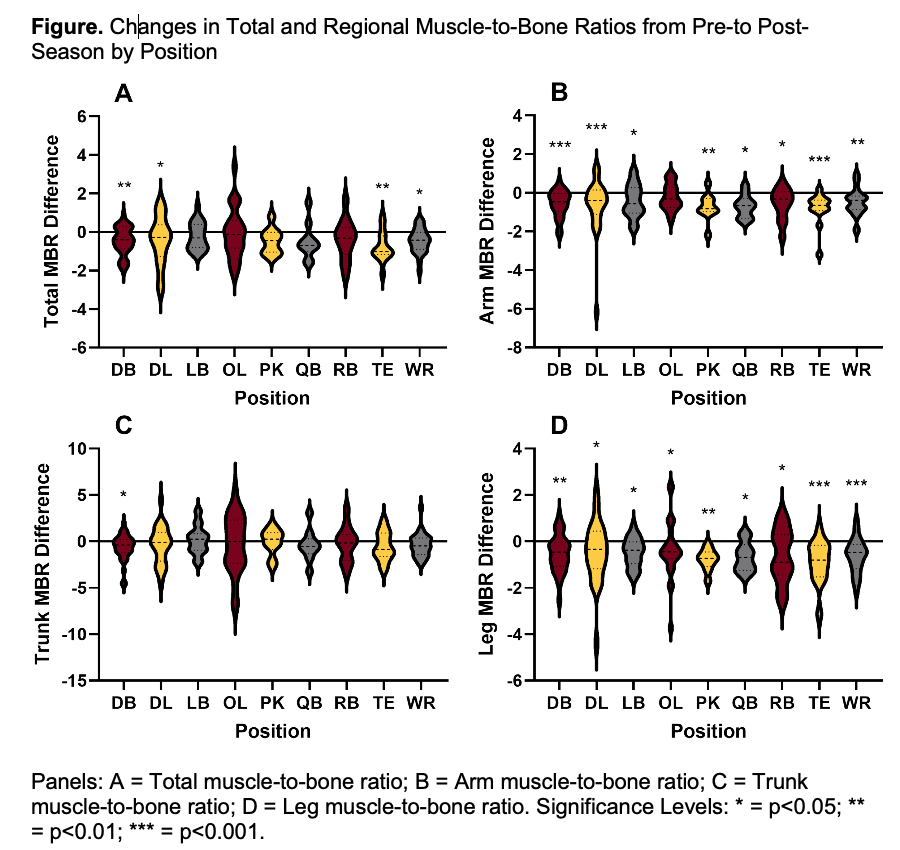
Figure. Changes in Total and Regional Muscle-to-Bone Ratios from Pre-to Post-Season by Position
Panels: A = Total muscle-to-bone ratio; B = Arm muscle-to-bone ratio; C = Trunk muscle-to-bone ratio; D = Leg muscle-to-bone ratio. Significance Levels: * = p<0.05; ** = p<0.01; *** = p<0.001.
Why This Matters for Coaches and Training Staff
The data in this papers suggests that even when bone mass remains stable, the muscular support for that bone is eroding as the season progresses. The result may actually be a decline in performance as well as an increased risk for injury.
Conclusion
Elite performance is not just about how much an athlete weighs on game day; it is about the quality of that weight. This research confirms that the "in-season slide" is a real phenomenon that affects nearly every position on the field. By monitoring athletes during the season teams may be able to stop the slide but also identify athletes who may be at risk for injury.
Reference: Brooks, SG and Dengel, DR. Position-specific longitudinal assessment of total and regional body composition in NCAA Division I football players. Journal of Strength and Conditioning Research 40(3): e241-e248, 2026.
About the Author
Donald Dengel, Ph.D., is a Professor in the School of Kinesiology at the University of Minnesota and is a co-founder of Dexalytics. He serves as the Director of the Laboratory of Integrative Human Physiology, which provides clinical vascular, metabolic, exercise, and body composition testing for researchers across the University of Minnesota.