Previously, I wrote a blog on the muscle-to-bone ratio (MBR). That blog discussed what the MBR was and how it could be applied to sports. I have continued to explore MBR in female rowers as well as collegiate and professional football players. As a continuation of our exploration into MBR and sports we recently published a paper in the International Journal of Sports Medicine (Westerberg et al., 2025) on muscle-to-bone ratio (MBR) in over 459 NCAA Division I collegiate male and female track and field athletes. There is a wealth of information in the article and I encourage you to read it if you want a more detailed look at the data. In this blog post we will examine the male track and field athletes data. In an upcoming companion post, I will focus on the female track and field athletes’ data.
Track and field athletes experience vastly different mechanical demands depending on their event, and these demands strongly influence how muscle and bone adapt over time. Understanding this balance is important not only for performance, but also for reducing injury risk. Recent research examining MBR and soft tissue-to-bone ratio (SBR) in NCAA Division I male track and field athletes provides valuable insight into how event-specific training affects skeletal health. MBR reflects how much muscle an individual has relative to bone mass, while SBR reflects total soft tissue relative to bone. These ratios offer a practical lens for understanding whether bone is adapting appropriately to the forces generated during training. When bone adaptation keeps pace with muscle development and impact loading, athletes are better equipped to tolerate high training volumes and intensities. So let’s look at our male track and field athletes.
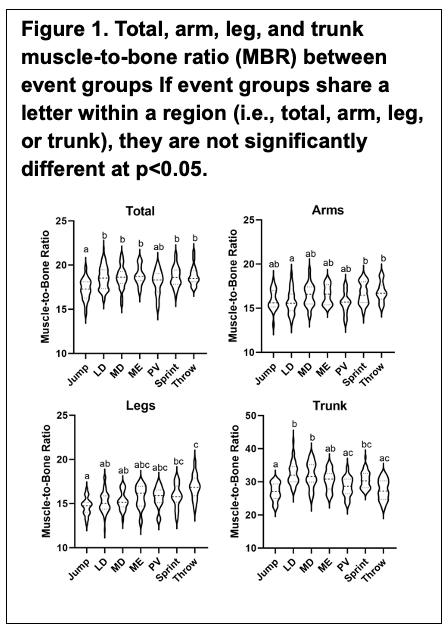
Total, arm, leg, and trunk muscle-to-bone ratio (MBR) between event groups (Figure 1).
Clear differences were observed between male event groups. Jumpers demonstrated some of the lowest total MBRs, meaning they had greater bone mass relative to muscle. This finding likely reflects the high-impact forces associated with jumping, which are known to be a powerful stimulus for bone adaptation. Previous research has shown enhanced bone strength in the jump leg of jumping athletes, and the current findings support the idea that event-specific training alone is sufficient to promote skeletal development in this group when volume is appropriately managed.
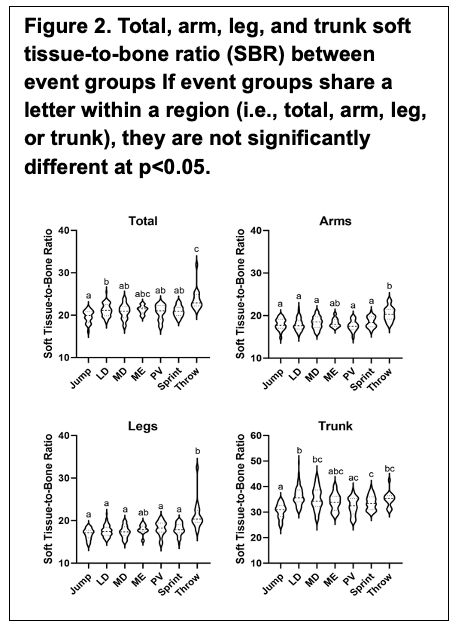
Total, arm, leg, and trunk soft tissue-to-bone ratio (SBR) between event groups (Figure 2).
Throwers, in contrast, showed higher total and regional SBRs. This pattern reflects the large amounts of lean mass and overall body mass required for throwing performance. While these athletes are well adapted for force production, the increased load placed on the skeleton highlights the importance of managing total training stress, recovery, and movement quality to support long-term bone health.
Male long-distance runners displayed a different pattern. This group showed elevated trunk MBR and SBR values (Figures 1 and 2) that were driven by lower bone mineral content in the spine and pelvis rather than increased muscle mass. These findings align with previous research showing that male endurance runners are at greater risk for low bone mineral density and bone stress injuries. Repetitive, high-volume running appears to provide insufficient stimulus for bone development in the trunk, particularly when muscle mass is low.
From a coaching perspective, the data presented here highlights the importance of structured strength training for male distance runners. Increasing muscle mass and strength especially in the hips and trunk may help absorb impact forces and reduce skeletal strain. Without sufficient muscular support, the skeleton may be exposed to excessive repetitive loading, increasing injury risk over time.
Overall, the male-specific data suggests that event-specific training is generally effective at promoting bone adaptation in power- and impact-based events such as jumping and throwing. However, endurance-focused training alone may not adequately support skeletal health. Monitoring athletes for signs of excessive fatigue, recurring bone injuries, or declining performance can help identify situations where muscle and bone adaptation may be out of balance.
For coaches, the key takeaway is that bone health in male track and field athletes is closely tied to training specificity and muscle development. Jumpers and throwers benefit from the inherent loading of their events, while distance runners require intentional strength training to support bone health. By aligning strength, impact, and recovery strategies with event demands, coaches can help male athletes remain healthy, resilient, and competitive throughout the season.
Reference: Westerberg HE, Stanforth PR, Carbuhn A, Bosch TA, Dengel DR: Muscle-to-bone and soft tissue-to-bone ratios in track and field athletes. International Journal of Sports Medicine 46:90-96, 2025.
About the Author
Donald Dengel, Ph.D., is a Professor in the School of Kinesiology at the University of Minnesota and is a co-founder of Dexalytics. He serves as the Director of the Laboratory of Integrative Human Physiology, which provides clinical vascular, metabolic, exercise, and body composition testing for researchers across the University of Minnesota.