A number of strength and conditioning coaches as well as athletes focus their training programs on building muscle mass in an effort to improve performance. But there’s another critical piece of the physiological puzzle that often gets overlooked: bones.
Bones are not just a static frame supporting our muscles; it’s a living organ that adapts to the physical demands place upon it. The muscles and bones of our body work as a dynamic team, communicating and shaping each other in response to movement and force.
It is this complex relationship between muscle and bone that my laboratory has started to examine in athletes as well as other populations. Using dual X-ray absorptiometry (DXA), we are able to accurately measure both bone mass as well as lean soft tissue mass. Using these measures, we can then calculate what is referred to as the Muscle-to-Bone Ratio (MBR).
Using the DXA, the MBR is calculated by dividing an individual’s total or regional Lean Soft Tissue (muscle mass) by their Bone Mineral Content (bone mass):


In a recent study we published in the International Journal of Sports Medicine, we examined the MBR as determined by DXA in 387 NCAA Division I female athletes across seven sports and compared their results to 209 age-matched college controls. Here is a look at what the research found, why the impact level of your sport matters, and how these insights can inform training and injury recovery.
Athletes vs. Non-Athletes: Surprising Similarities & Regional Differences
The study analyzed female collegiate athletes in basketball, cross-country, diving, soccer, softball, swimming, and volleyball, comparing them with age- and BMI-matched non-athlete female college students.
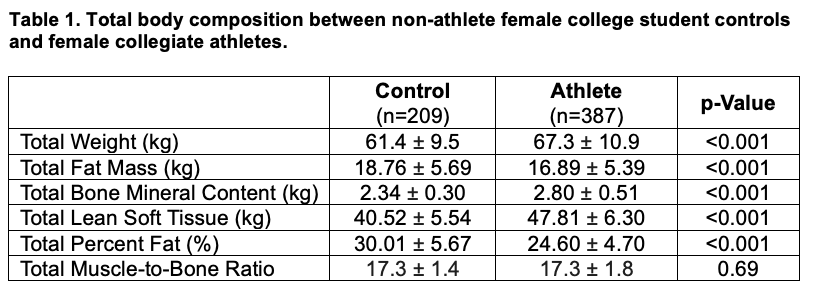

At first glance, total MBR was identical between athletes and non-athletes (17.3 for both groups). Because elite athletes build both significantly more muscle and significantly more bone mineral content, their overall ratio balanced out (Table 1).
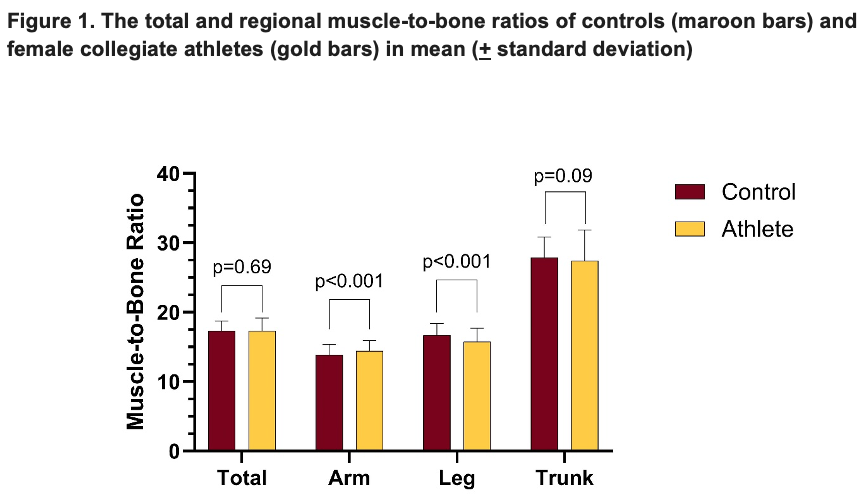
However, when we broke down the data by body region distinct differences emerged (Fig. 1).
- Arms: Athletes (gold bars) showed a significantly greater arm MBR (14.4 vs. 13.8, p<0.001) due to elevated upper-body muscle development required for sport performance.
- Legs: Non-athletes(maroon bars) actually had a greater leg MBR than athletes (16.7 vs. 15.7, p<0.001). This isn't because athletes have weaker leg muscles, but because sports involving jumping and running stimulate substantial bone density gains in the lower extremities, lowering the numeric ratio.

High Impact vs. Low Impact Sports
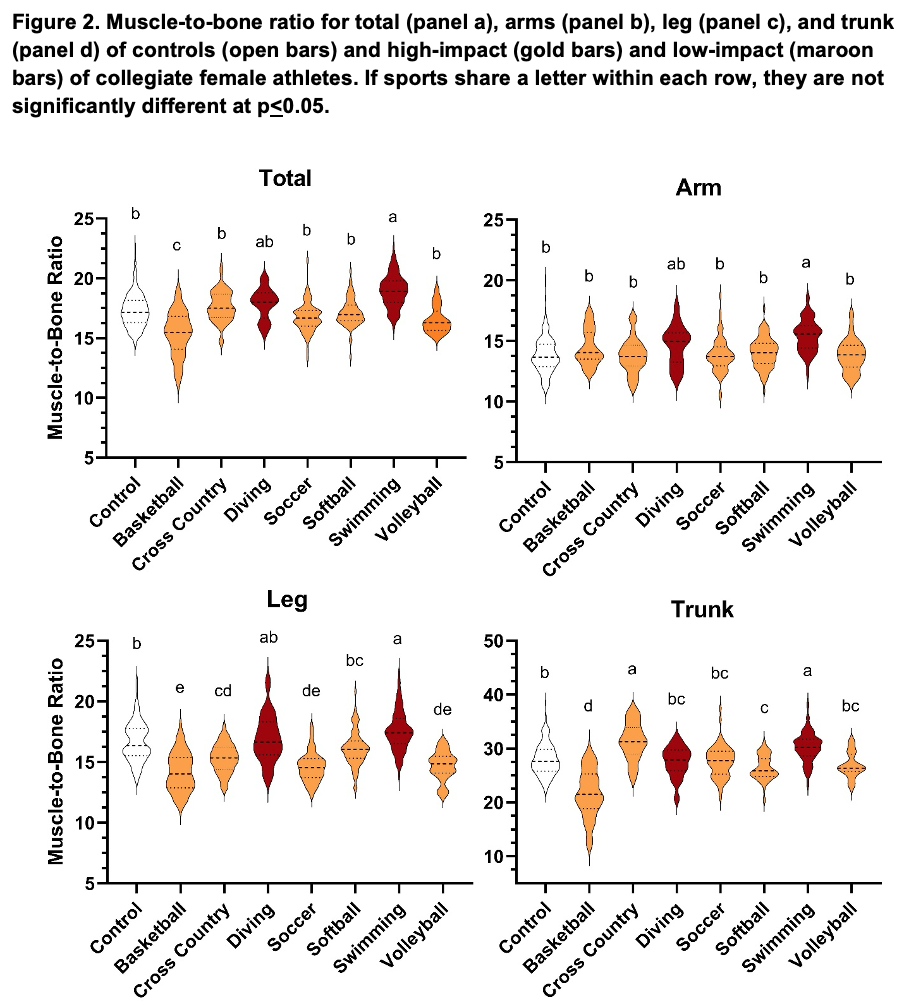
The most striking findings occurred when comparing sports against one another based on mechanical load and impact levels (Fig. 2).
- High-Impact Sports (gold bars): Basketball, Volleyball, Soccer, Softball, and Cross-Country
- Low-Impact Sports (maroon bars): Swimming and Diving

Key Findings:
1. Swimmers Have Higher MBRs: Athletes in non-weight-bearing sports (maroon bars) like swimming exhibited significantly higher overall and regional MBRs than high-impact (gold bars) athletes. Swimming builds substantial lean muscle, but because water provides buoyancy, there is minimal impact or mechanical strain to trigger heavy bone mineralization.
2. Impact Drives Bone Density: Basketball and volleyball players displayed the lowest leg MBRs (14.2 and 14.7, respectively). Repetitive jumping, landing, and rapid change-of-direction movements generate intense ground reaction forces, prompting bones to adapt by becoming significantly denser.
Key Takeaways for Coaches, Athletes, and Trainers
1. Incorporate Resistance & Weight-Bearing Exercises for Non-Weight-Bearing Athletes:
Swimmers and divers build impressive muscle mass, but water-based training lacks the ground reaction forces needed to maximize bone mineral content. Supplementing aquatic training with land-based, weight-bearing, or plyometric exercises can promote bone health and lower injury risks over a career.
2. Personalized Baseline Monitoring:
Because DXA accurately distinguishes between bone mass, muscle mass, and fat mass without relying on standard skinfold assumptions, measuring baseline MBR gives sports medicine professionals a clear physiological profile for each sport position.
3. Informed Rehabilitation Protocols:
Tracking regional MBR can serve as a valuable marker during post-injury recovery. If an athlete experiences localized muscle atrophy or altered bone load during recovery, tracking changes in regional MBR provides objective benchmarks to guide safer return-to-play decisions.
Reference
Dengel DR, Juckett WT, Stanforth PR, Evanoff N. Muscle-to-Bone Ratio in Collegiate Female Athletes in Low and High Impact Sports. Int J Sports Med. 2026; 47: 206-211.
About the Author
Donald Dengel, Ph.D., is a Professor in the School of Kinesiology at the University of Minnesota and is a co-founder of Dexalytics. He serves as the Director of the Laboratory of Integrative Human Physiology, which provides clinical vascular, metabolic, exercise, and body composition testing for researchers across the University of Minnesota.